
A roof leaking in heavy rain needs its entry point traced, even if the dripping stops when the shower passes. Greater water flow exposes blocked drainage and weak junctions; wind also changes how rain reaches the covering. Start by keeping the affected area safe, then record what you can see without climbing onto the roof. Best Top Roofing Ltd investigates leaks and carries out emergency roof repairs across our Hertfordshire and Northamptonshire areas. Call 07429 820474 and describe what is happening.
Protect people before trying to protect the room
Keep everyone away from a bulging ceiling or loose material outside. Do not puncture a swollen ceiling or stand beneath it to catch water. Move belongings only if the area is safe; a container for drips is useful beneath a sound ceiling away from electrical fittings. If water reaches lights, sockets or wiring, keep clear and switch off the electricity at the consumer unit only if you can do so safely from a dry position. Arrange an electrician's assessment before restoring affected circuits. A light switch alone does not make wet wiring safe. Leave ladders and roof access to the roofing team, especially during rain or wind. When you call, say immediately if water is near electrics, the ceiling is sagging or anything has become loose above an entrance.
Record the pattern while staying indoors
Note when the dripping began, how long the rain had been falling and whether gusts arrived with it. A leak that appears immediately under wind pressure gives different clues from one that starts after an hour of steady rain. Photograph the stain and its position in the room, including a wider view showing the nearest wall or chimney breast. From a safe window, record overflowing gutters or a displaced roof tile if visible. Avoid opening a wet loft or stepping between joists to chase the water. Tell the roofer about recent roof work, new aerial fixings or an extension built against the house. These observations help organise the inspection, but they do not prove the cause. Water travels before it emerges indoors, so the external defect is not necessarily directly above you.
Check the drainage route when rainfall increases
A gutter that copes with a light shower still overflows when its outlet is restricted. Leaves and compacted silt reduce the space available for flow; a blockage in a downpipe bend then backs water up to the roof edge. Depending on the eaves detail, that water reaches behind the fascia or into an existing defect at the edge of the covering. Valleys deserve the same attention because they collect runoff from adjoining slopes into a narrow channel. The inspection should establish whether the problem is debris, poor alignment, inadequate discharge or damage to the lining. In a terrace, the outlet also serves the adjoining run if drainage is shared. Removing visible leaves is only one part of the check: the rainwater has to reach its discharge point through the entire agreed route.
Inspect where pitched roofing meets another surface
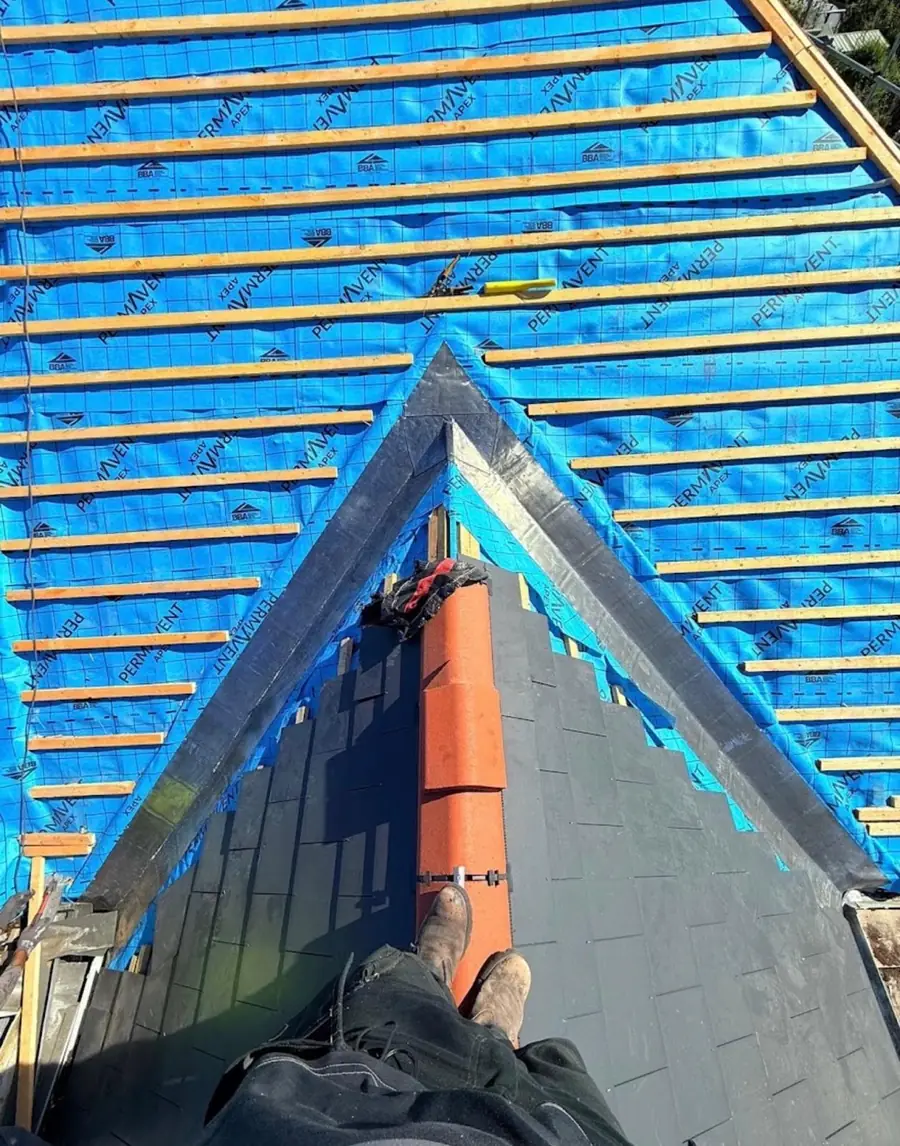
Tiles and slates shed rain through their shape, pitch and overlap. A displaced piece, broken interlock or unsuitable lap weakens that arrangement, particularly when wind pushes water towards a joint. The inspection needs to consider the covering and the underlay beneath the affected section together. At a chimney or wall, lead flashings and soakers guide water over successive roof courses. Cracks, loose fixing or an exposed gap let water bypass those details. Rain also enters through defects in the chimney itself, so leadwork should not be blamed without checking the masonry above it. A stain beside a rooflight calls for examination of its drainage channels and connection to the covering. The practical question is which water path has failed, followed by how far the surrounding material needs opening to rebuild it.
On a flat roof, look at the edges and water level
Flat roof leaks need the perimeter checked along with the surface. Water held by a restricted outlet reaches laps, corners and wall upstands for longer than freely draining rain. An open felt joint, damaged rubber detail or crack in a fibreglass laminate then gives it a route below. Wet decking spreads the moisture, which explains why an indoor drip appears some distance from the entry point. The survey should assess the outlet position, deck levels and height of the wall connection. Repeatedly adding another covering raises the surface without correcting a low flashing or a sagging base. A proper proposal identifies those level problems before choosing a repair or replacement. Do not walk onto the roof to clear a drain yourself: wet coverings, weak boards and rooflights need appropriate access precautions.
Rule out condensation and other sources of moisture
Not every wet patch in a roof space begins with rain getting through the covering. Warm moist air from the rooms below condenses on cold surfaces when the roof's moisture control and ventilation are inadequate. More widespread droplets or dampness that also appears during dry weather deserve investigation of that possibility. A leaking pipe or tank is another source to check when the pattern does not follow rainfall. No single visual clue settles the diagnosis, and a roof can have condensation alongside a rain leak. Describe when the moisture appears rather than deciding the cause in advance. Blocking vents to stop a draught does not resolve the underlying design issue. The inspection should distinguish defects in the weatherproofing from problems with ventilation, insulation or plumbing before work is specified for the building.
Arrange protection and a repair that addresses the cause
Call Thomas on 07429 820474 and give the property address, the affected room and any immediate hazard. Best Top Roofing Ltd is open Monday to Saturday, 8am to 6pm; attendance is discussed during the call. If temporary protection is needed, its purpose and price should be clear before it is agreed. Once the roof can be inspected safely, we identify the failed detail and give you a free fixed written quotation for the repair. That includes explaining whether the task is clearing drainage, replacing damaged covering, renewing leadwork or dealing with a defective flat roof base. Homeowners, landlords and small businesses deal directly with the family doing the work. Keep your notes of the leak, and allow the inside to dry after the source has been fixed before arranging any redecoration.
Get a fixed price for your roof
Ranges are a guide. The real number comes from someone looking at your roof. We come out, show you what is needed and give you a fixed written price, free and with no pressure.
Questions
Why does my roof stay dry in light rain?
A small amount of water gets through a partly restricted drain without overflowing, while heavier flow backs up. Wind also pushes rain towards weak laps and flashings. An inspection needs to check drainage and the covering rather than assuming the intermittent leak has stopped.
Can I put sealant around the ceiling stain?
Sealing the inside does not repair the route through the roof and conceals a useful symptom. Keep clear of damaged plaster and wet electrical fittings. Record the stain safely, then have the external cause investigated before decorating or sealing the affected area.
Does a leak during a storm mean the whole roof is damaged?
No. A single defective junction or blocked outlet is enough to let water indoors. The survey checks how far the problem extends and the condition of neighbouring materials. Best Top explains the required repair and provides a written price before you decide.