
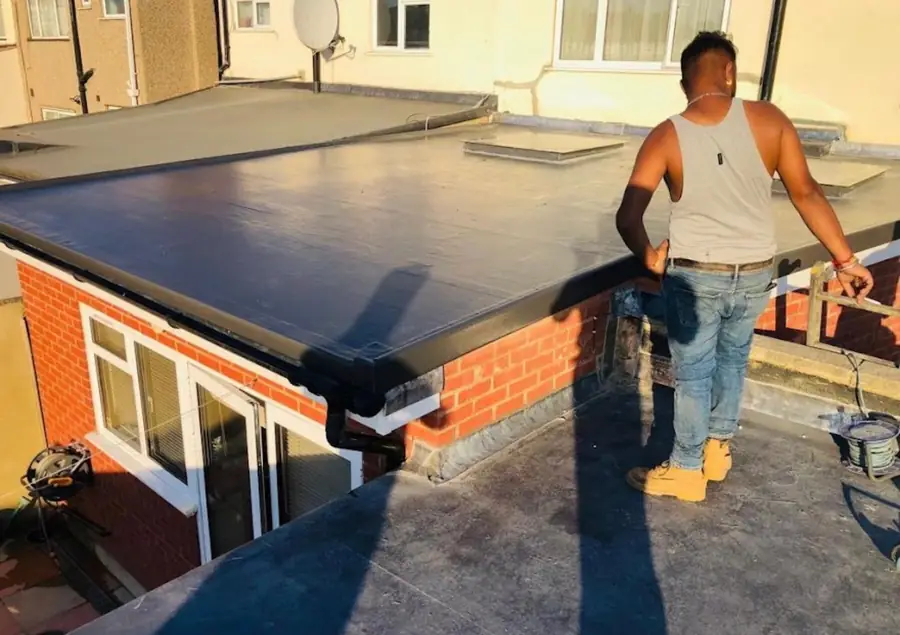
EPDM vs GRP is a useful comparison when you are replacing a flat roof, and modern roofing felt deserves a place in the discussion too. Rubber is flexible, conventional fibreglass forms a rigid laminate, and felt uses a built-up bitumen covering. Each needs a suitable base and correctly formed junctions. This guide explains the choices for Hertfordshire and Northamptonshire garages, extensions and dormers. Best Top Roofing Ltd installs all three systems. Call 07429 820474 for an inspection and a free written quote.
Begin with the roof's shape and how it will be used
Draw the outline of the roof and mark every wall, rooflight, pipe and outlet. That simple sketch makes the choice more useful than comparing rolls or resin tins. A clear garage rectangle offers long uninterrupted areas, while a kitchen extension with a lantern has corners and vertical connections that take more detailing. Tell the roofer whether the room below is heated and whether anyone needs maintenance access across the covering. A balcony or occupied terrace needs a designed walking surface and supporting structure; ordinary roof waterproofing does not establish suitability for that use. The condition of the base matters next. Loose boards, inadequate support and poor drainage need resolving whichever system is selected. Decide those requirements first, then compare how each covering fits the shape, installation conditions and intended use.
EPDM offers flexibility, with careful detailing at its edges
EPDM is synthetic rubber supplied as sheet material. On a suitable small roof, a large sheet reduces the number of field seams, although corners, outlets and penetrations still need purpose-made details. The membrane is bonded to a compatible substrate, with the specified adhesive and perimeter restraint. Its flexibility helps accommodate movement, but loose decking underneath is still a defect. Where a seam is needed, preparation and the correct primer and tape determine the connection; a fold pressed into an internal corner is not a finished waterproof detail. Rubber suits clear roof areas and also handles more complex shapes when properly detailed. Protect it from sharp objects and use specified protection along maintenance routes. Ask where the joins and terminations will fall on your particular roof before deciding how suitable the system is.
Conventional GRP depends on the deck and curing conditions
A conventional GRP roof uses glass reinforcement saturated with resin over the specified deck, followed by the system's protective finish. Edge trims and reinforced junctions connect the main laminate to the perimeter. The result is a firm surface, but its performance depends on the boards underneath being dry, adequately supported and installed to the system instructions. Board joints, changes of plane and larger roof areas need the appropriate reinforcement or movement details. Installation also requires suitable weather and temperature so the resin can be mixed, applied and cured correctly. GRP allows neat detailing around corners and rooflight kerbs without making every complicated roof automatically a fibreglass job. For regular foot traffic, request a specifically designed finish and construction. A hard-looking surface alone does not make a standard roof a usable terrace.
Roofing felt is a specified layered system
Modern built-up felt roofing uses reinforced bitumen membranes laid as a system with defined overlaps and a weathering layer. Torch-on work bonds suitable layers through controlled heat, with the installation method chosen around the roof's construction and fire precautions. Combustible details and hidden cavities need assessment before a torch is used; alternative detailing is required at unsuitable locations. That preparation belongs with the installer, not a homeowner trying a repair with a burner. Felt works on garages, extensions and other flat roof shapes, with the corners and abutments formed from the correct components. Its joints remain deliberate parts of the system rather than evidence of poor workmanship. Ask about the actual specification, the base and the method at difficult junctions. A product described simply as felt gives too little information to judge.
Compare maintenance and guarantees on their actual terms
The useful life of a flat roof depends on installation, drainage, maintenance and the stresses it receives. A headline lifespan on a product leaflet does not tell you the condition of a particular roof or promise how long every component will last. Clear leaves from outlets through safe access arrangements and report loose trims, open joints or damage before water reaches the deck. Keep the installation specification and any maintenance instructions, especially if later work involves an aerial, solar equipment or a new rooflight. Compare a manufacturer's material warranty with the installer's workmanship terms, including the requirements for raising a problem. Best Top guarantees workmanship; its 10 year guarantee applies to new re-roofs, so ask for the terms relevant to your flat roofing quotation. Keeping those documents clear makes future decisions much easier.
Repairability matters when something damages the covering
A puncture in otherwise sound EPDM needs a compatible repair with the correct cleaning and preparation. Local damage to GRP requires the laminate's condition to be assessed before reinforcement and resin are applied. A sound felt system supports a specified patch or local renewal, with proper bonding and overlap. In each case, the repair has to address the base if water has softened the deck. General-purpose paint or sealant over a wet defect does not establish a durable repair. Future access also matters: a roof trapped behind adjoining extensions needs a practical maintenance route after the installation is complete. In Watford's terraces or an enclosed St Albans garden, discuss that route before the job. Ease of repair is a combination of compatible materials, a sound substrate and the ability to reach the fault safely.
Use the survey to compare two suitable options
For an open garage roof, ask how EPDM and felt compare once the same deck repairs and drainage work are included. For an extension with several kerbs or awkward corners, include GRP in the discussion and ask the installer to explain each proposed junction. The shape alone does not dictate a winner. Get the exact system, preparation, insulation, outlets, flashings and access written into the quotation, then compare totals for equivalent work. Thomas can inspect your roof and talk through those choices without asking you to select a material first. Best Top Roofing Ltd is family-run and fully insured, with the family carrying out the work. Our written quotations are free and carry no obligation. Ring 07429 820474 to arrange a survey for your home, rental property or small business roof.
Get a fixed price for your roof
Ranges are a guide. The real number comes from someone looking at your roof. We come out, show you what is needed and give you a fixed written price, free and with no pressure.
Questions
Can EPDM be fitted around a rooflight?
Yes. Rubber systems have compatible details for rooflight kerbs, corners and adjoining surfaces. The installer needs to plan them with the membrane layout and upstand height. A rooflight does not automatically make GRP the only suitable choice for the roof.
Is GRP strong enough to use as a balcony?
A balcony needs its structure, waterproofing and walking surface designed for that use. Standard GRP roofing is not automatically a balcony specification. Tell Thomas about regular access or outdoor seating before quotation so the proposal reflects the intended use.
Should I rule out felt when replacing an old leaking felt roof?
No. Establish why the old roof failed first. Worn material, defective laps, poor drainage and a soft base call for different work. A correctly specified new felt system remains an option, alongside EPDM and GRP, after the underlying defects are addressed.